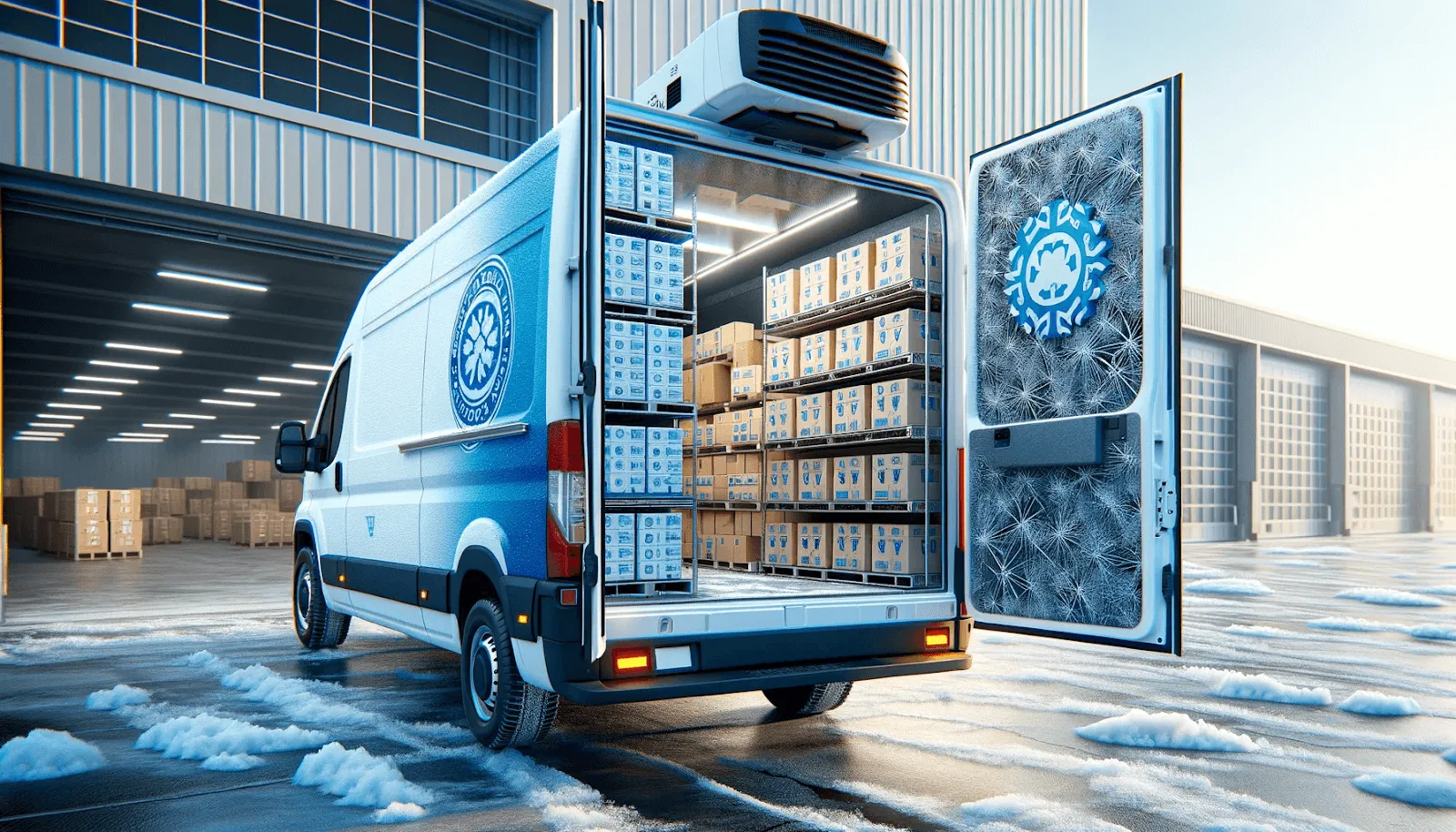
A refrigerated trailer has an insulated body and a refrigeration unit, which keeps goods at the set temperature, chilled or frozen. In the UK, a category B licence covers a trailer of up to 3,500 kg maximum authorised mass (MAM), with a combined MAM of up to 7,000 kg. France and Belgium are stricter: behind a vehicle of up to 3,500 kg, B covers a trailer of 750 kg or less or a combination of up to 3,500 kg, then you need mention or code 96, then BE. To carry perishable food, you often need an ATP certificate, and its class tells you what temperature the trailer can hold.
Which licence do you need to tow a refrigerated trailer?
The licence depends on the maximum authorised mass, not on the weight of the day’s load. That mass is called MAM in the UK, PTAC in France and MMA in Belgium.
| Maximum authorised mass | United Kingdom | France and Belgium |
|---|---|---|
| Trailer of 750 kg or less | B | B |
| Trailer over 750 kg, combination of 3,500 kg or less | B | B |
| Trailer over 750 kg, combination over 3,500 kg, up to 4,250 kg | B | B with mention 96 (France) or code 96 (Belgium) |
| Trailer over 750 kg, combination over 4,250 kg | B, with a trailer of up to 3,500 kg and a combination of up to 7,000 kg | BE (in France, trailer of up to 3,500 kg; in Belgium, combination of up to 7,000 kg) |
| Vehicle over 3,500 kg, up to 7,500 kg (C1), with a trailer over 750 kg | C1E, combination of up to 12,000 kg | C1E (in France, combination of up to 12,000 kg; in Belgium, combination under 12,000 kg) |
Each country adds its own details:
- In the UK, every category B licence holder has had B+E, the British equivalent of BE, automatically since 16 December 2021, whatever the date of their test. Drivers who got their licence before 1 January 1997 can usually drive a combination of up to 8,250 kg.
- In France, mention 96 requires a 7-hour training course at an approved establishment or association. The C1E licence also covers a category B vehicle with a trailer over 3,500 kg.
- In Belgium, code 96 and the BE licence both require passing a practical test, possible from age 18.
Rules checked in November 2026.
How do you register and test your trailer?
These obligations also change with the maximum authorised mass and the country.
| Country | Registration | Roadworthiness test |
|---|---|---|
| United Kingdom | Must be registered over 750 kg to drive to or through most European countries | Annual test for semi-trailers and for trailers over 1,020 kg unladen with powered braking |
| France | Its own registration certificate over 500 kg | None up to 3.5 t, except semi-trailers and dangerous goods |
| Belgium | Its own registration over 750 kg, with a plate starting with Q; below that, a copy of the towing vehicle’s plate | Test after registration and before first use; in Flanders, every trailer over 750 kg goes through the technical inspection |
In the UK, a trailer must have a working brake system if it weighs over 750 kg when loaded. In Flanders, a trailer over 750 kg has its own brakes.
Rules checked in November 2026.
When do you need an ATP certificate?
ATP is the international agreement concluded in Geneva on 1 September 1970 on the carriage of perishable food. It applies when loading and unloading take place in two different States and unloading takes place in a country that is party to the agreement. Each country then sets its own conditions:
- In the UK, ATP covers international journeys, and different rules apply within the country. The initial certificate lasts 6 years, then the vehicle or trailer is retested every 3 years.
- In France, according to Cemafroid, the body delegated by the Ministry of Agriculture, the Code rural requires vehicles carrying perishable food to hold an ATP certificate, required for international transport between signatory States, or a certificate limited to French territory, for equipment with equivalent guarantees. No certificate is required for a journey of less than 80 km from the loading point without opening the doors. A certificate for equipment in service is renewed at 6 and 9 years by a test in a centre recognised by the Ministry of Agriculture, then at 12 years in an official test station. The marking is blue for ATP and red for the national certificate.
- In Belgium, issuing or changing an ATP certificate carries a fee of 25 euros, not counting the inspection body’s charges.
What temperature does an ATP class guarantee?
The class letter tells you what temperature mechanically refrigerated equipment can hold, according to the ATP text.
| Class | Temperature inside |
|---|---|
| A | Adjustable from +12°C to 0°C |
| B | Adjustable from +12°C to −10°C |
| C | Adjustable from +12°C to −20°C |
| D | 0°C or lower |
| E | −10°C or lower |
| F | −20°C or lower |
Insulation counts too. A normally insulated body (IN) has a K coefficient of 0.70 W/m².°C at most, a heavily insulated body (IR) 0.40 W/m².°C at most, and classes B, C, E and F require 0.40 W/m².°C at most. The FRC marking means class C mechanically refrigerated equipment with heavy insulation.
What temperature does ATP require for each product?
Its annexes set the maximum temperature of the product.
| Product | Maximum temperature |
|---|---|
| Ice cream | −20°C |
| Frozen or quick-frozen fish, molluscs and crustaceans, and all quick-frozen food | −18°C |
| Other frozen food | −12°C |
| Frozen butter | −10°C |
| Minced meat | +2°C, or the temperature on the label or transport documents |
| Red offal | +3°C |
| Poultry, rabbit | +4°C |
| Raw milk | +6°C |
| Meat products, pasteurised milk, fresh dairy, ready-cooked food | +6°C, or the temperature on the label or transport documents |
| Red meat | +7°C |
| Untreated fish, molluscs and crustaceans | On melting ice, or at its temperature |
Rules checked in November 2026.
What are the maximum dimensions?
In the UK, a trailer can be up to 2.55 m wide, and a vehicle of 3,500 kg or less cannot tow a trailer longer than 7 m. In the European Union, an articulated vehicle measures 16.50 m at most, and a trailer, semi-trailers aside, 12 m. The maximum width is 2.55 m, or 2.60 m for the body of a temperature-controlled vehicle, whose walls are at least 45 mm thick, and the maximum height is 4 m.
Rules checked in November 2026.
What types of refrigerated trailer are there?
- The insulated trailer has no refrigeration unit: only the insulation of its body holds the temperature.
- The trailer with a refrigeration unit controls and adjusts the temperature inside its body.
- The small refrigerated trailer suits small businesses and local deliveries.
- The two- or three-axle trailer spreads the weight better, for larger loads.
- The refrigerated semi-trailer is used mainly for long distances and carries a large number of pallets.
These trailers mostly carry perishable food: meat and fish, fruit and vegetables, ready meals. They are also used, for example, for cut flowers. Some units can also warm the air in the body, which protects goods from frost in winter.
How does a refrigerated trailer work?
A refrigerated trailer holds a product’s temperature rather than chilling it down. Its unit does not blow in cold air: it removes heat from the air inside the body. The compressor feeds the evaporator, the air loses heat as it passes over the evaporator, then it circulates through the whole trailer again.
How do you use a refrigerated trailer properly?
Hitch the trailer
- Apply the trailer’s parking brake.
- Lower the trailer’s legs, if it has them.
- Remove the anti-theft device.
- Use the jockey wheel to bring the coupling head to the height of the towball, then lower it onto the towball and lock it.
- Attach the breakaway cable.
- Connect the towing socket to the vehicle’s electrical supply.
- Raise the jockey wheel and the legs, then release the parking brake.
Load the body
Put heavy, sturdy goods on the floor without pressing them against the walls: the load is more stable and the cold air circulates better. A refrigeration unit needs time to reach the set temperature, so bring the body to temperature before loading.
Manoeuvre the combination
Get used to the combination’s dimensions before you set off. When reversing, the trailer generally moves in the opposite direction to your vehicle’s steered wheels.
Unhitch the trailer
- Park both vehicles on flat, firm ground.
- Apply the trailer’s parking brake.
- Disconnect the towing socket and the breakaway cable.
- Lower the legs and the jockey wheel until the coupling head comes off the towball.
- Fit the anti-theft device.
Look after your refrigerated trailer
- Cleaning: wash the body often with hot water, not steam, which can damage sensitive parts. Clean the door seals and rails too.
- Before each departure: check the locking system, the electrics, the parking brake and the legs.
- Every week: inspect the doors and the condition of the body. A damaged seal or a badly fitting door can break the cold chain.
- Regularly: check the chassis and the tyre pressure.
- At a specialist: have the refrigeration unit and the trailer inspected, to catch faults before they become expensive.
Deliver with your refrigerated van
Refrigerated transport is most of Shippr’s business. Our partner couriers deliver in refrigerated vans, carrying chilled goods (0 to 4°C, or 0 to 7°C depending on the goods) and frozen goods (−20°C). If you are a self-employed courier with a refrigerated van, sign up as a refrigerated vehicle driver. If you do not have one yet, our article on refrigerated vehicles helps you choose one.