There are five ways to preserve food: with cold, with heat, by changing the air around it, by taking water out of it or by acidifying it. Cold slows or stops bacteria without destroying them; heat destroys some or almost all of them, depending on the treatment. For refrigeration, the legal limit runs from +2 °C to +8 °C depending on the product and the country, and a quick-frozen food is kept at −18 °C or colder.
| Family | Methods | What it does |
|---|---|---|
| Cold | Refrigeration, freezing, quick-freezing | Slows bacteria without killing them |
| Heat | Pasteurisation, sterilisation, canning | Destroys some or almost all bacteria |
| Atmosphere | Vacuum, protective atmosphere | Removes or replaces the air |
| Less water | Drying, salting, sugar, freeze-drying | Deprives micro-organisms of available water |
| Fermentation | Lactic, acetic, alcoholic | Transforms the food using yeasts or bacteria |
Preserving with cold
Cold slows the reactions that spoil food and the growth of micro-organisms. It does not get rid of them: France’s Ministry of Agriculture points out that some bacteria survive freezing, and multiply again when the defrosted product warms up (agriculture.gouv.fr).
Refrigeration
Refrigeration keeps food a few degrees above zero: this is the chilled range. France sets these maximum storage temperatures (table from France’s Ministry of Agriculture):
| Food | Chilled, maximum | Frozen, maximum |
|---|---|---|
| Minced meat | +2 °C | −18 °C |
| Fresh fish | +2 °C or melting ice | −18 °C |
| Dishes prepared in advance | +3 °C | −12 °C |
| Poultry, rabbit | +4 °C | −12 °C |
| Meat cuts | +4 °C | −12 °C |
| Carcasses, large pieces | +7 °C | −12 °C |
| Ice cream | — | −18 °C |
France’s limit for dishes prepared in advance applies in retail. For other highly perishable foods, including those with a use-by date, France sets +4 °C in direct sale and in institutional catering, and +8 °C for other perishable foods; in storage and transport, the manufacturer or packer sets the temperature under their own responsibility.
These limits differ from country to country. In Belgium, the Royal Decree of 13 July 2014 sets a maximum of 7 °C for, among others, meat products, cut vegetables and fresh cheese (opinion of the scientific committee of AFSCA, the Belgian food safety agency). For cold processing, AFSCA gives butchers 7 °C for butcher’s meat, and 4 °C for poultry, minced meat and meat preparations (AFSCA guide). In England, a business commits an offence if it keeps on its premises, above 8 °C, food in which pathogens can grow, subject to exemptions (Food Safety and Hygiene (England) Regulations 2013), and the UK’s food safety agency advises a fridge between 0 and 5 °C (Food Standards Agency).
Freezing
Freezing turns the water in food into ice, which deprives micro-organisms of the water they need. At −18 °C, bacteria are on pause, not dead (Food Standards Agency). Nor is −18 °C the rule for everything: in France, many frozen foods may be stored at −12 °C (see the table above).
Do not refreeze a defrosted product: France’s Ministry of Agriculture advises against it, because it encourages bacteria to grow. The Food Standards Agency allows one exception: food that has been defrosted and then cooked can be frozen again, and then reheated once only.
Quick-freezing
Quick-freezing is rapid freezing, as the law defines it. Under EU law, the food passes as quickly as its nature requires through the zone where the water crystallises most, then stays without interruption at −18 °C or colder at every point (Directive 89/108/EEC). The directive allows brief rises of at most 3 °C during transport, and of 3 °C in local distribution and in retail display cabinets, and a member state may raise that last margin to 6 °C in a cabinet. England’s rule also sets −18 °C, and it allows a quick-frozen food to be warmer only for brief periods in transport, including local distribution, no warmer than −15 °C, or in a retail display cabinet, no warmer than −12 °C (Quick-frozen Foodstuffs (England) Regulations 2007). Under the directive, the label of a quick-frozen food meant for consumers or restaurants must say clearly that it must not be refrozen after defrosting.
The difference from a frozen product therefore lies in how fast the temperature falls and in the temperature guaranteed afterwards. We also cover this in Frozen or quick-frozen: what is the difference?
Rules checked in October 2026.
Preserving with heat
Pasteurisation
Pasteurisation destroys pathogenic micro-organisms with a moderate heat treatment, followed by rapid cooling. For milk, EU law sets at least 72 °C for 15 seconds, or at least 63 °C for 30 minutes, or any equivalent combination (Regulation (EC) 853/2004). The product keeps its taste better than after sterilisation, but pasteurisation does not destroy everything: you keep most pasteurised products in the fridge.
UHT treatment goes further: it heats milk in a continuous flow to at least 135 °C, for a suitable time, so that it keeps at ambient temperature in a sealed sterile pack.
Sterilisation and canning
Sterilisation heats food more strongly than pasteurisation. It does not necessarily remove every micro-organism: the Codex Alimentarius speaks of biological stability, meaning a food in which no micro-organism can grow under normal storage conditions without refrigeration (Codex Alimentarius).
Canning applies this treatment to food already sealed in an airtight container, such as a tin. That is why a tin keeps outside the fridge. To choose the right container, read our guide to food packaging.
Rules checked in October 2026.
Preserving through the atmosphere
- Vacuum. You remove the air around the food. Less oxygen limits the growth of many micro-organisms and oxidation.
- Protective atmosphere. You replace the air in a sealed pack with a gas or a mix of gases suited to the product. EU law, retained in the UK, then requires the words ‘packaged in a protective atmosphere’ on the label (Regulation (EU) 1169/2011).
Rules checked in October 2026.
Preserving by reducing water and by fermentation
Micro-organisms need available water, and a food’s water activity measures it. According to the FAO, most pathogenic micro-organisms do not grow when it falls below 0.86, and yeasts and moulds rarely below 0.62 (FAO). Salt and sugar bind water, which has the same effect as drying.
- Drying and dehydration. You remove all or part of the water from the food.
- Freeze-drying. You freeze the food, then place it under vacuum: the ice turns directly into vapour. The method preserves shape and flavour, but it is expensive.
- Salting and brining. You cover the food with salt or immerse it in a salt solution, for example for cured meats.
- Candying. You immerse the food in a sugar syrup, for example for candied fruit. Confit is also the name for a food cooked slowly and then kept in its own fat.
- Smoking. You expose the food to smoke from burning plant material, usually after drying it. The FAO notes that the antimicrobial agents in smoke can allow dried meat products to be dehydrated less (FAO).
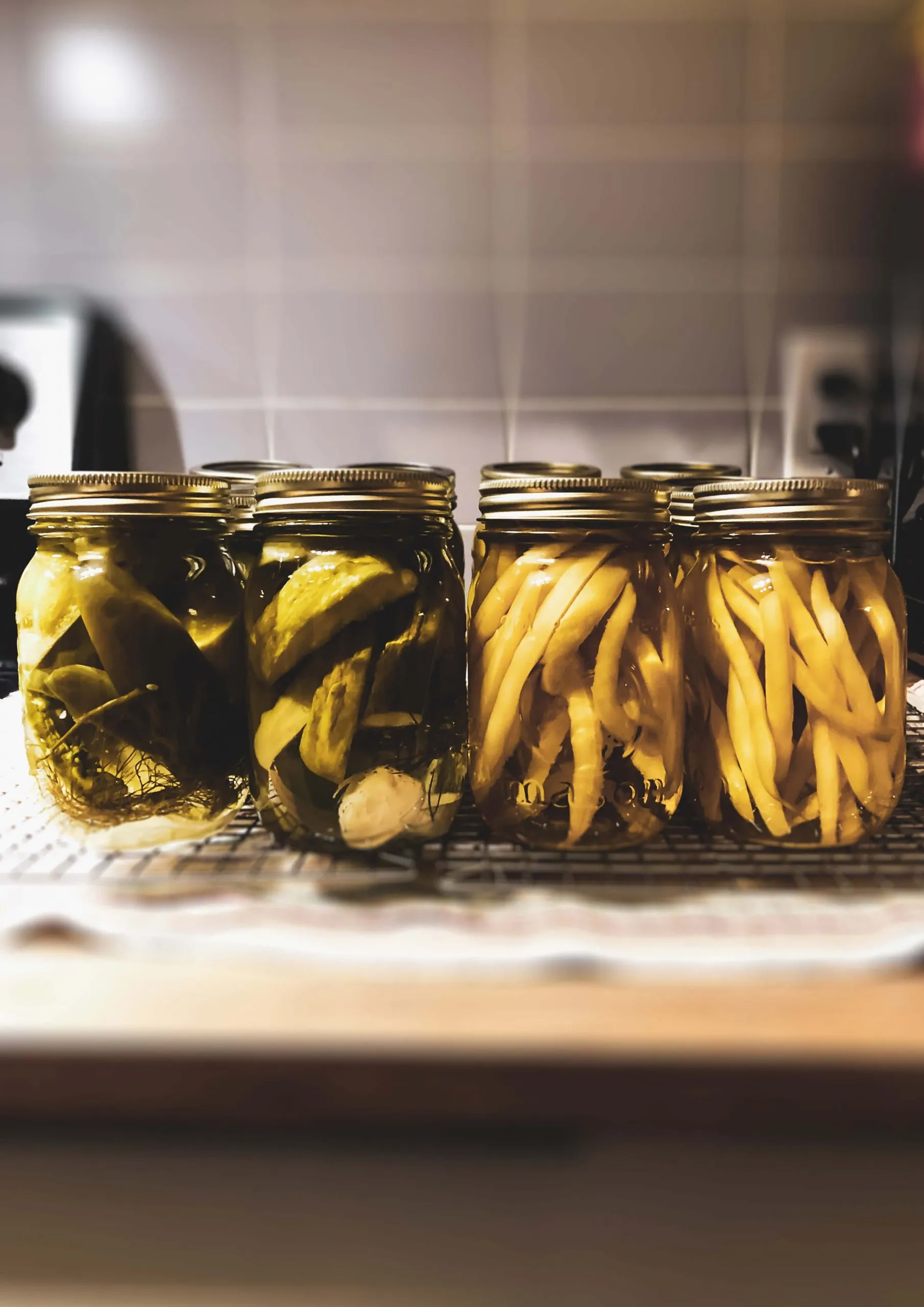
- Fermentation. Yeasts or bacteria transform the food. Alcoholic fermentation produces wine, lactic fermentation sauerkraut and cheese, and acetic fermentation vinegar.
Transport is part of preservation
A cold method is only worth anything if the temperature holds all the way to the customer: if food warms up during delivery, putting it back in a cold room does not destroy the bacteria that have multiplied in it. We handle your refrigerated transport in a refrigerated vehicle reserved for your goods and pre-cooled before loading: chilled (0–4 °C, or 0–7 °C depending on the goods) or frozen (quick-frozen goods, at −20 °C). On your regular multi-drop rounds, an on-board logger records the temperature continuously and we alert you to any deviation. For the rules on the journey, also read How do I transport frozen products?